The dancing chicken


Herzog was his hero, and Herzog was a concomitant factor in his suicide. He was with his parents and he didn’t want to put his dad through watching this film late at night, so he went home to watch this tragic, romantic film where the hero commits suicide at the end. You know the famous last line, where there’s a dead man in the cable car, and the chicken is still dancing, which is why with our usual sense of fun we put the chicken’s feet on the [run-out?] of the first three sides of Still, then on the last side, the chicken stops here.” (Tony Wilson)


01

02

03

De skändar Ian Curtis och Joy Division

Nästan exakt på dagen 35 år efter att Ian Curtis hängde sig i sitt kök är jag på väg till Dramaten för att se en föreställning som heter “Kärleken kommer att skilja oss åt”. Jag tänker på hur KLF:s Bill Drummond i en av sina böcker skämtar om hur man blir känd över en natt.

645@70

Nästan exakt på dagen 35 år efter att Ian Curtis hängde sig i sitt kök är jag på väg till Dramaten för att se en föreställning som heter “Kärleken kommer att skilja oss åt”. Jag tänker på hur KLF:s Bill Drummond i en av sina böcker skämtar om hur man blir känd över en natt.

Aha, det är så man gör! tänkte Bill Drummond när Ian topped himself. Lets kill Mac and get famous! Mac var Ian McCulloch, sångare i Echo and the Bunnymen som Drummond var manager för.

Det var inte bara Ian Curtis som dog. De dog som flugor. Producenten Martin Hannett av hjärtattack som följd av osunt leverne, 42 år. Factorybossen Tony Wilson av cancer, 57 år. Managern Rob Gretton av hjärtattack som följd av hypertyreos, 46 år.

Jag tänker även på Thomas Bernhard som skriver om självmordet som det enda riktiga alternativet, men saknar modet och karaktär att ta livet av sig. Han föraktar sig själv för att han lever vidare, ack det torftiga överlevandet! Hans djupt älskade morfar såg på världen som en kloak där de vackraste och mest komplicerade former tar gestalt om man tittar tillräckligt länge.

Ian Curtis tittade inte tillräckligt länge. Stackars Ian som har fru och en frisk dotter, stackars Ian som måste skaffa sig en mystisk, exotisk älskarinna som förstår honom och som följer med på turnéerna trots att inga andra flickvänner får.

Finns det något mer patetiskt än män som tycker att fru och barn är så futtigt? Som tror att det finns något mer där ute? Och som likt Ian ändå inte låter frun gå, som inte ger henne skilsmässa? Det skulle jag vilja se en föreställning om. Men Sally Palmquist Procopés inspirationstolkning av utvalda Joy Division-låtar påstås handla om allas ungdom. Det blir tunt.

Den vackra unga skådespelerskan sjunger “Folk som du tror det är enkelt / Naket, självklart / Språnget över himlen” (“Atmosphere”). Tyvärr är det inte enkelt, det där språnget över himlen kräver större ansats än så här. Det är som att de har ridit höga på en idé som såg briljant ut på papperet.

De skändar inte bara Ian Curtis och Joy Division, utan även översättaren Sara Stridsberg och musikerna i Tonbruket. Varför Joy Division, när Nirvana finns och passar deras enkla tema bättre?

När ensemblens vitklädda marionettdockor som skådissjunger- och buskisdansar har spelat klart kan de fråga om studentskivorna behöver ett gäng som skrålar till “Love will tear us apart”.

Men en kvinna som sitter nära mig gråter. Uppenbarligen berör de någon.

“Gå inte ifrån mig, i tystnad / gå inte ifrån mig” (“Atmosphere”).

Jag hoppas att de som ser den här föreställningen tänker på dem som blev kvar. På änkan Deborah Curtis och dottern Natalie Curtis (i dag 36 år och fotograf i Manchester), de som stannade kvar och kämpade. De som tittade tillräckligt länge.

© Linda Skugge

When Performance Lost Control: Making Rock History out of Ian Curtis and Joy Division

“Who is right, who can tell, and who gives a damn right now”
344588204
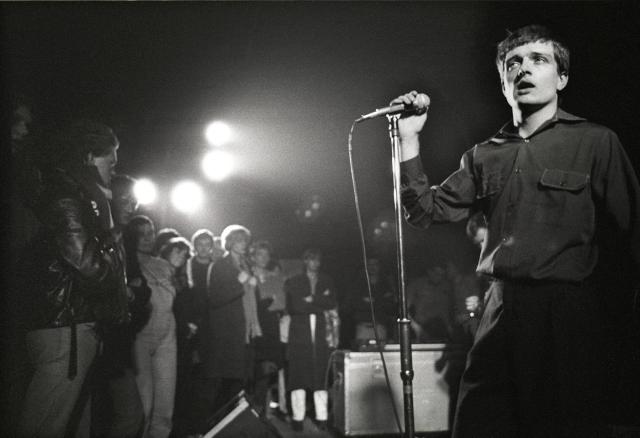
This is a case study of the continuities between living, performing and writing. When Ian Curtis hanged himself at the age of 23, tortured by epilepsy, medication, fear and remorse; having just started a promising career as singer and songwriter for the band Joy Division, after releasing two intriguing long plays and a hit single called “Love Will Tear Us Apart”, and about to embark on their first American tour, he was staging his ultimate performance. The act turned him into a cult figure, as it gave an eerie resonance to the increasingly gloomy lyrics he had written for his band.

Music journalists began to write about Joy Division in a more vivid, dramatic way. People who had never seen the band perform live, or even heard of them while Curtis was alive, became fans. Joy Division was hailed in their native Manchester, England, as youthful symbols of the postmodern city, and in the rest of the world as founders of the gothic rock scene. They were subsequently the subject of biographies, biopics and documentaries which focused particularly on Curtis’s personality, and the main webpage devoted to the band (joydivisioncentral.com) lists about twenty Joy Division tribute bands performing their songs, while Youtube enables fans and critics to watch the band perform at several gigs on very low quality footage, and much more visually appealing clips of actor Sam Riley performing as Ian Curtis in the biopic about him, Control (2007). At present the hyperreal Curtis of Control seems to be on the verge of replacing the real one, since video and image searches are often directed to Riley’s role-playing rather than to Curtis himself. I was probably not alone in returning to Joy Division and Ian Curtis with a renewed enthusiasm after watching the movie.

As I will never have the chance to see Joy Division perform live, I will have to be content with re/viewing other people’s writings on a band “who capture the imagination and make history with an incandescent performance that would be studied for years” (Morley 17). However, as Phelan reminds us, “performance cannot be saved, recorded, documented, or otherwise participate in the circulation of representations of representations: once it does so, it becomes something other than performance […]. The document of a performance is only a spur to memory, an encouragement of memory to become present”; in other words: it becomes history, and, by that token, narrative writing. I will therefore dwell on the descriptions of Joy Division’s performance by others, particularly those who met the band and attended their live performances. My interest is archeological: it is history of, but also as, performance. No attempt will be made to reconstruct a lineal history, however, or to disguise my modest experience as a fan. I adopt a collage approach to performance studies (Kilgard) in order to restate the multifaceted complexity of the Joy Division myth in a kaleidoscopic form, rather like the tracks in a conceptual album which need not be read in sequential form, except perhaps for the present opening section and the concluding one.

Writing Joy Division: David Morley’s performative approach to history writing

I will not argue the matter: Time wastes too fast: every letter I trace tells me with what rapidity Life follows my pen. (Sterne)

I was among the many who discovered Joy Division’s music too late, when the band no longer existed. I probably heard “Love Will Tear Us Apart” on the radio in later 1980 or ‘81. Then I went to my local record shop, saw the mysterious funereal cover of their second album, Closer, and asked the shop assistant to play it for me on one of the turntables they had for customers. It is hardly possible to recall over thirty years later why I liked their music, but I believe I can retrieve much of the feeling by reading one of Paul Morley’s later descriptions of it. In the opening section of his Nothing (2000), “a northern memoir concerning Stockport, the self and suicide,” Morley imagines Ian Curtis’ dead body miming to the words, “This is the way, step inside,” from “Atrocity Exhibition,” the first track on Closer:

Drums would be pummeled with detached precision, bass guitar would ramble up from deep out of the ground and a guitar, as if it were an electronically charged knife, would cut through the atmosphere (…). The voice the body was miming would croon with a kind of objectless longing, an urgent aimlessness. (Morley)

The problem of representing performance that Morley is facing here resembles Hazel Smith and Roger Dean’s descriptions of their work in the electronic ensemble austraLYSIS in “Live Music; Dead Bodies” (2012). Smith and Dean also imagine a dead musician performing, as well as staging an ironic protest against “the genetic manipulations, transplants, abortions and acts of voluntary euthanasia that are regularly carried out on music and austraLYSIS’s performances.” Similarly, Morley seems to be wondering whether performance can ever be brought to life, except as variously manipulated fiction.

If Morley is sometimes considered the writer who best accounts for the art of Joy Division, it is not just because he was relatively close to them at some of their turning points, but also thanks to the performative character he has been trying to imbue his writing with through the years, exhibiting what Phelan calls, “The open hand writing; the emptiness of the word carving a space for others to inhabit”. In Joy Division Piece by Piece: Writing about Joy Division 1977-2007 (2008), Morley emphasizes a sense of writing performance in three ways: by bringing together different pieces of writing (in chronological order, but interspersed with recent introductions and commentaries, and some of them not dealing with Joy Division, but with groups considered within their entourage, such as Buzzcocks or Cabaret Voltaire) in the manner of a collage rather than a unitary compilation; by insisting on history as something provisional, present, and future-oriented, as it seems to him, “it’s more appropriate not to create a settled version of events but to keep the versions of events always moving, and therefore part of the current world, not part of a disappearing world”; and, finally, by always revealing a personal bias in his narrative, for example when he repeatedly relates his experience of Joy Division to the suicide of his own father at the age of 40 in 1977, the year when Morley also saw the first concerts by Warsaw, the band who would soon rename itself Joy Division. Morley’s biography of the band and his history of their Northern England scene are purposefully impinged upon by his autobiography and his claim to being their chronicler: after all, he was learning to write about rock music professionally as Joy Division was learning to play. He thus suggests how the personal element is paramount in anyone’s exposition to music as performance. He is also acutely aware of the difficulty of writing anything final about Joy Division—of turning performance, or a life, into a book.

Controlling stories

According to legend, it was Tony Wilson, a TV broadcaster who owned Joy Division’s label Factory Records, who took Morley to see Ian Curtis’ corpse, because he needed that experience to write “the book” about the band (Curtis, Middles and Reade).

In fact, the task to write the primary Joy Division biography was taken up by the singer’s widow, Deborah Curtis, whose daughter Natalie was just a year old when her father left them. She wrote the book partly to take control of the story of Ian Curtis from Tony Wilson and the music world in general, which she largely blames for her husband’s death (Curtis). It is most unusual for a rock star’s wife to be the one to narrate his authoritative biography. The reputed music critic Jon Savage, in his preface to Touching from a Distance, mentions “something that is ever present but rarely discussed, the role of women in the male, often macho, world of rock” (Curtis xiii). Savage then cites a key scene in the book which is duly represented in the film Control, when she was pregnant and the organizers of a gig objected to her presence at the venue: as she wryly commented on it, “from the point of view of managing a band, it made sense to keep their respective women away. (…) If Ian was going to play the tortured soul on stage, it would be easier without the watchful eye of the woman who washed his underpants” (Curtis). Thus Touching from a Distance succeeds in demystifying Ian Curtis and turning the tables on the myth that the author believes to have killed her husband. There is also a sense of reckoning at work: the chance to pay back the partner who betrayed her, taking historical control over the dead body. The book offers an essential experience of Joy Division’s mind and intellect, even if one may also get an uncanny feeling of puppetry and ventriloquism about it, as when Morley imagines Curtis’ dead body crooning to the music of Joy Division. The same ventriloquism can be felt whenever we use, as she does in her book, the titles or lines of his songs as headings of chapters interpreting his life.

A further act in this struggle for control of Curtis and Joy Division’s story is the alternative biography that Wilson’s ex-wife Lindsay Reade would co-write with the music journalist Mick Middles, Torn Apart: The Life of Ian Curtis (2006), where, with no thanks to Deborah, they clearly adopt the perspective of Tony Wilson, Ian’s sister and parents, and his mistress, Annik Honoré, a refined Belgian groupie. Annik is allowed to absolve herself from accusations that she reacted insensitively to Curtis’ epileptic fits by declaring that, precisely when he suffered them, she “loved him more than ever because he was utterly lost” and that on those occasions he actually looked “supernatural,” as he was “kind of glowing and was literally rising from the ground” with the convulsions (Middles and Reade). Such intimations of mysticism are confirmed by suggestions of his clairvoyance, Annik’s virginity throughout her relationship with Ian (they always refrained from intercourse and “slept together like two kids”, the way his body was found after the rope had stretched and “he was knelt on the floor as though he was praying”, and Annik’s dream of a strong light through which Ian was telling her “he had managed to find peace now”
.

Besides the memoir and the cult biography, another way of recreating Joy Division’s story in writing is by integrating it within the history of popular culture, art and life in Manchester since the late 1970s. This is what Michael Winterbottom’s film 24Hour Party People and Tony Wilson’s novelization of the screenplay, 24 Hour PartyPeople: What the Sleeve Notes Never Tell You, do. In every book on Joy Division, to some extent, the band and its fated genius represent metonymically the Mancunian environment in which the band members grew up and Curtis ultimately died. Ott, for instance, argues that “the sense of despair and frustration that Curtis’s lyrics conveyed had broad implications in the England of the late 1970s, where hopelessness was a very real sensation,” and Manchester in particular “was in state of economic stasis”. Today’s “romantics” like to imagine that Joy Division played “Manchester music emerging from the grimy residue of its lost industrial heritage” (Middles & Reade). This historical focus is more accurately developed in Grant Gee’s documentary Joy Division (2007), written by the music journalist Jon Savage. It makes a point of adding the social realism which was found largely missing from other accounts, such as the film Control, where “It’s hard to guess from its beautifully silvery photography that it is set in the 1970s, a period of strikes and conflict and de-industrialisation, when Manchester was grimy and deserted” (Sandhu). In the initial images of the documentary we hear the narrator’s voice (Jon Savage) over a nocturnal view of Manchester city: “I don’t see this as the story of a pop group, I see this as the story of a city that once upon a time was shiny and bold and revolutionary.” Then, over images of kids playing in derelict 1970s streets, Tony Wilson’s voice tells us “it felt like a piece of history which had been spat out—this had been the historic centre of the modern world. We invented the industrial revolution in this town …” Images of the industrial revolution and a young working girl from the 19th century fade into that of a 1970s girl playing around ruined council flats, and other images of kids playing in desolate streets, an abandoned car, demolished housing estates, and a horsed-policeman, leading to the surviving members of Joy Division relating their experience growing up in such settings. Thus the documentary responds to Tony Wilson’s ambition to give the Joy Division experience a transcendental sense as embodying the drama of postmodernity in Northwest England.

Writing performance: the absent subject

Without a copy, live performance plunges into visibility – in a maniacally charged present – and disappears into memory, into the realm of invisibility and the unconscious where it eludes regulation and control. (Phelan)

The history of Joy Division’s performance always begins with the legendary Sex Pistols gigs at the Lesser Free Trade Hall in Manchester, June 4 and July 20, 1976, which were hailed as “the Emotional Revolution” that would push the 19th-century city of the Industrial Revolution into the 21st century (Morley). Commenting on the “problematic reconstruction” of the June 4 gig in the film 24 Hour Party People, and on more accurate attempts to recall the performance of the Sex Pistols there (Nolan), Albiez argues that, besides the people who saw the Sex Pistols on those occasions and how they were inspired by them, their cultural impact had to do with a combination of factors including the press coverage of the events in Sounds, New Musical Express and Melody Maker, and the Sex Pistols’ appearance on Granada TV’s So It Goes, among others. These same music papers and TV program would be decisive for Joy Division’s initial popularity.

The Sex Pistols alone, however, would not suffice to explain Joy Division’s outlook on performance. It is crucial to take account, as Middles and Reade do, of the fascination held since the early 1970s by “those performers who were pushing at the boundaries,” especially David Bowie, and Iggy Pop, “another right performer at exactly the right time” for Curtis to learn from. Bowie offered a model for drama and creative personal transformation, while Pop would chiefly stand for sheer intensity, as well as a certain feeling for stage self-immolation: “In witnessing the performance [of Iggy Pop on March 3, 1977, in Manchester Apollo], Ian Curtis had taken a step closer to realizing his own dream” (Middles and Reade). The last record Curtis heard before dying was Pop’s The Idiot, which was made in close collaboration with Bowie. Thus it is important to stress that Curtis’ style of performance, far from depending only on his solipsistic genius, resulted from his attendance to other rock artists’ performances, and is therefore embedded in a history of performance.

Joy Division’s special contribution to the history of performance is often defined as the rare intensity of Curtis’ creation. Analyses of his performance highlight its “frightening” intensity (Morley). Thus Savage prefaces Deborah Curtis’ book by stating that it was “a performance so intense you’d have to leave the hall,” as Curtis shed the performer’s “necessary psychic self-possession” and “surrendered himself to his visions” entirely on stage (xii). Deborah Curtis, generally focusing on the closeness between his performance and his suicide, portrays him as “a performer from a very early age” who “seemed to be forever taking his fantasies to the extreme”. For Wilson, Joy Division members were not limited to rock star posing, they were “artists who ‘meant’ it. More than meant it. Had no choice” (2002). They would take their performance to the last extreme and beyond that. Various metaphors have been used to describe the way Curtis danced. At the time it was commonly referred to in the music press as the “dead fly dance” (Ott).

More dramatically, Morley has referred to it as “trapped butterfly flapping” (Morley). In a July 1979 issue of Melody Maker Jon Savage explained how “Live, he appears possessed by demons, dancing spasmodically and with lightning speed, unwinding and winding as the rigid metal music folds and unfolds over him”; in the same month Mick Middles wrote in Sounds how Curtis “often loses control. He’ll suddenly jerk sideways, and, head in hands, he’ll transform into a twitching, epileptic-type mass of flesh and bone” (Ott). Ott distinguishes two systemic patterns of dance in Curtis’ performance:

In the more famous, his right arm crosses his hips as the left swirls in an arc past his face: this movement gives the impression of a man swimming desperately for shore, trying to get the leading edge of time itself behind him. The second pattern is more disturbing to behold, a less-ordered flailing at the elbows, like a child swatting a swarm of mosquitoes”.

Ott adds that these movements indicate “pre-seizure activity,” and so does a third one, in which “as Ian’s head darts from side to side, like a spinning top, you can see his eyes are staring straight ahead, locked onto some object that kept him rooted in the moment” (Ott). For Morley, in sum, focusing particularly on the movement of his feet running on the spot (Morley), “He danced with controlled uncontrollability as if he wanted to outstrip the speed of the planet. His epileptic fits sickly emphasized his need to move faster than the world” (Morley). All these images touch on the singer’s urge to dance faster than the band’s music tempo, to go beyond, as it were anticipating his tragic departure from his mates, and the continuity between his performance and his epileptic condition.

Performing sublime: ritual as violent spectacle and the failure of speech acts

The title of the first song on Closer, “Atrocity Exhibition,” comes from a book by J.G. Ballard about a character called Dr. Nathan, in whose mind “World War III represents the final self-destruction and imbalance of an asymmetric world, the last suicidal spasm of the dextro-rotatory helix, DNA. The human organism is an atrocity exhibition at which he is an unwilling spectator”. Curtis’ song lyrics, in turn, begin with an image of “Asylums with doors open wide / Where people had paid to see inside, / For entertainment they watch his body twist, / Behind his eyes he says ‘I still exist’…” For those who knew about his epileptic fits on stage, the allusion to watching “his body twist” would be unmistakable. In this light may also be interpreted the gladiatorial imagery in the song’s next stanza after the obsessively repeated refrain, “This is the way, step inside”: “In arenas he kills for a prize, / Wins a minute to add to his life. / But the sickness is drowned by cries for more, / Pray to God, make it quick, watch him fall” (Curtis). Although the song’s imagery later adds apocalyptic “mass murder” and “dead wood from jungles and cities on fire,” the burden of interpretation tends to remain with the singer offering his fight on stage, the gradual destruction of his body by a twisting sickness, for a paying audience. Some of his dancing movements actually resembled a fight against an invisible enemy, which was perhaps his physical and moral decline.

The meaning of “Atrocity Exhibition,” and of the artist’s stage image as a whole, can also be compared to the spectacle of the French performance artist Orlan, who, since 1990 was having cosmetic surgeries and videotaping them for art exhibitions. Although Orlan’s aim may be to “challenge the patriarchal imperative to control the body” (Faber), a political aim Curtis was not concerned with, the overall aesthetic effect of both artists’ performances concur with the meditations of the philosopher Georges Bataille upon the bodies of torture victims: “like Bataille, Orlan enacts the transformation of self into a sacred figure and art. Her art dissolves distinctions between subject and object, author and work” (Faber). Curtis realized that his body, especially because of the close connection between his dance and his epilepsy, between his lyrics and his life, had become a public site of performance, and the object of a ritual that could lead up to immolation. The criticism implicit in Curtis’ performance is against the terrible demands of the rock culture on the devoted artist.

We are not usually supposed to take song lyrics literally. Not even those closest to Curtis really believed his performance of suffering was something he was living through, both offstage an on. His drama did not just represent, it actually presented what was happening. The “unknown pleasures” of Joy Division were, as in Lyotard’s definition of the postmodern sublime, the pleasure and pain of presenting the unpresentable (Counsell and Wolf). They would finally believe him when he overdid his stage performance, fatally lost control, and killed himself. However, in doing so he was also losing control of his meaning, as the various contradictory accounts of his life and end suggest. Like the woman having an epileptic fit in Joy Division’s “She’s Lost Control,” Curtis “gave away all the secrets of [his] past.” His act bespeaks the failure that pervades speech act and every performance (Phelan). For suicide must be an unhappy speech act according to J.L. Austin’s (1975) notion of performative utterance, provided suicide is regarded as an action that makes a very messy, controversial statement.

Living myth: performativity, intertextuality and suicide of rock stars

Arguably no other “rock ‘n’ roll suicide” was accomplished so dramatically and meaningfully. From his first attempt (as narrated by Ott) Curtis seemed to be planning his suicide as a performance responding to the ideas he found in songs by David Bowie like “All the Young Dudes” and “Rock’ n ’Roll Suicide.” There seems to be a deliberate intertextuality, or hidden suicide note, between his death and the lyrics of Iggy Pop’s “Tiny girls” in the record which was found spinning on his turntable, which speaks about not wanting to live because of bitter disappointment with girls (the last person he spoke to was his wife, who was determined to proceed with their divorce), and the last film he watched, Werner Herzog’s Stroszek, whose hero, a musician, shoots himself after travelling hopefully to America only to be betrayed by his girlfriend and by an economic system which is symbolized in the final scene by some chickens that are made to play and dance obsessively inside a slot machine. He seemed to be acting on a script, whether by Pop and Bowie; by Herzog; by Jon Savage, in his review of Unknown Pleasures where mentions taking rope in the house of a hanged man (Savage); or by the no less premonitory funereal sleeves of Closer and Love Will Tear Us Apart. Furthermore, he was improving on the “heroic” deaths of other rock stars like Jim Morrison, which look more accidental. Curtis seemed to act on the idealized lines of songs calling for a youthful death, rather than imitating actual rock and roll suicides.

These are some of the many traces he left behind for interpretation. Ultimately, whether Curtis’ suicide was planned or accidental, and how far it was inspired by the music he heard or the films he watched, are highly speculative matters. It was a solitary, deeply personal act. Even those who met him personally and write about him with a degree of knowledge, like Deborah Curtis, Morley, Wilson, Annik, or Middles and Reade, can only claim a fragmentary understanding of his motivations, which therefore remain overdetermined. For those of us who never met him or even saw him play live, he is very much a historical, almost fictional, character who lived in a distant epoch, and we can only approach him in a profoundly mediated way, through the writings of witnesses to his life and performance.

Morley’s mission with regard to Joy Division, and, for that matter, that of every fan, critic or biographer of a band’s performance, may be fruitfully compared to what the photographer Sophie Calle did in the Isabella Stewart Gardner Museum in Boston, after several paintings were stolen in 1990. Calle asked visitors and museum staff to describe the stolen paintings, transcribed these texts, and placed them next to her photographs of the galleries, suggesting “that the descriptions and memories of the paintings constitute their continuing ‘presence’, despite the absence of the paintings themselves” (Phelan). As Phelan points out analyzing Calle’s performative art from a Lacanian perspective, “The description itself does not reproduce the object, it rather helps us to restage and restate the effort to remember what is lost (…). The disappearance of the object is fundamental to performance; it rehearses and repeats the disappearance of the subject who longs always to be remembered” (Phelan). Writers like Morley cannot really aim to achieve full control of Joy Division’s story; they just keep encouraging others to listen to the band, write about it, and “perform” it to themselves and others, much like Sam Riley interpreting Ian Curtis in Corbijn’s film, because they think it has a present and future historic relevance as an enduring myth.

“Insight”: My Unknown Pleasures sweatshirt

I believe we should be wary of passing judgment on Curtis’ act, for instance, by comparing Curtis to “Goethe’s infamous creation, Werther” (Ott 94). The only fairminded approach to his case is probably a subjective one. Therefore I should state my position as a fan. I probably never heard of Joy Division until the band had disappeared. At the time Joy Division was playing, my favorite rock group was Genesis. Annik did not want Joy Division to adopt the pretentious sound of progressive rock that punk reacted against (Morley).

When I became a fan of Joy Division, I was also listening to post-punk bands like The Durutti Column, The Cure, Bauhaus, The Church, and Throbbing Gristle. I still enjoyed the music of the former generation (e.g., Supertramp, Genesis, Pink Floyd, and Yes), along with more “pop” post-punk music like The Smiths, Ultravox, Talking Heads, and (of course) New Order, in addition to many Spanish groups, some of which, particularly Décima Víctima, showed a remarkable Joy Division influence. In the 1980s I became infatuated with “gothic rock” aesthetics and moods, which I complemented with readings of Sartre, Camus, Samuel Beckett or John Fowles. I see myself in a faded picture rowing in the Lake District in the autumn of 1985, aged 23, wearing a sweatshirt with the famous Unknown Pleasures pattern. Life is but a dream. I assumed E.M. Cioram’s dictum, “The man who has never imagined his own annihilation, who has not anticipated recourse to the rope, the bullet, poison, or the sea, is a degraded gallery slave or a worm crawling up the cosmic carrion.” To me, Ian Curtis was a presence like the dreams that keep calling him in “Dead Souls” (though I always imagined I would die listening to Yes’ “Close to the Edge”). I was under his spell until, around 1990, my wife—my own controlling “Debbie Curtis”—told me to get that bloody suicide nonsense out of my head. I survived Joy Division.

Breaking “Glass”: uncontrollable metaphors

Accounts of Curtis’s life tend to be dominated by certain controlling metaphors, conforming a discourse on Joy Division which draws on the lyrics and is often based on binaries like outside/inside (as in the design of Unknown Pleasures, in the chorus of “Atrocity Exhibition,” and in the title of Peter Hook’s memoir); distance (as the title of his biography, Touching from a Distance, a line from “Transmission”); closeness (as in the album Closer); or control and its loss. Glass-breaking imagery is by no means less revealing. Yet its meaning in Joy Division’s songs is purely figural, and its contrived obscurity bears comparison to the connection between title and lyrics in Bowie’s song “Breaking Glass” from Low (1977), a favorite of Curtis’, the meaning of which is notoriously difficult in terms of symbolic connotations.

The biographies of Ian Curtis relate various glass incidents in the singer’s life. His wife illustrates his self-directed violence narrating incidents when he broke a glass door during an argument with her, smashed glasses, or was so manic on stage he didn’t mind rolling around a broken glass (Curtis). We may catch glimpses of possible symbolic significances of glass in the singer’s career, culminating at the concert in Bury that “turns into a riot, as if to symbolize to Curtis a world that was disintegrating, a life that was over” (Morley). The riot resulted from an attempt to replace Curtis, because of his severely declining health, with another singer. It started when someone in the audience threw a bottle at a beautiful crystal chandelier hanging above the stage. Those on stage “got completely showered with shards of glass and bits of chandelier” (Middles and Reade). The way this moment is represented in the various accounts of Curtis’s career bears comparison to the episode in Brian Gibson’s film Breaking Glass (1980), when a punk singer played by Hazel O’Connor sees a young man die from a stabbing in front of her stage, in the middle of a riot which a concert of her band, precisely called “Breaking Glass,” had provoked. She falls into a deep depression that makes her lose control of her career, an opportunity which her record company seizes to manipulate her at their will. Unlike the fictional singer in that film, however, Curtis had no loving manager to save him in the last resort. Blaming himself for the disaster at Bury and “Weeping uncontrollably (…) [, Curtis] in all likelihood crossed a boundary on the night of April 8th from which he never returned” (Ott). This was really when performance lost control. He died 40 days later, on May 18th. The lyrics he had been writing for Closer and “Love Will Tear Us Apart” have been read as his suicide note (Reynolds), in spite of the deliberate ambivalence pop song words may often have.

Since glass seems to have acquired a peculiar symbolism in relation to Joy Division, from the glass-breaking effects in “I Remember Nothing” (the last song in Unknown Pleasures, 1979) to New Order’s “Crystal,” it is worthwhile considering its presence in the lyrics of two other Joy Division songs, one of which was written quite early in the band’s brief existence, and the other late: “Glass” (1978) and “Something Must Break” (1980). While some of the song titles are explicitly repeated in the lyrics and often form the chorus, in “Glass” the connection between title and lyrics can only be inferred. Likewise, in “Something Must Break” the title phrase is used twice in the last stanza, but its relation to previous lines can only be guessed at: those lines are, “If I can’t break out now, the time just won’t come” (one of his characteristic hopeless statements), “Looked in the mirror, saw I was wrong,” and “I see your face still in the window,” the latter being the first line in the final stanza, which repeats “Something must break (now)” in the third and last lines, suggesting that what breaks may be the window, probably also the mirror.

The play of association and free inference is also the one at work in Touching from a Distance and other biographies of the band which use titles from the songs as chapter titles, inviting readers to find symbolic connections between the narrative in the chapter and the songs, even though, as Morley knows too well, Curtis’ words “omit links and open up new perspectives: they are set deep in unfenced, untamed darkness” (Morley). Indeed Wilson states, “It’s disgusting the way some people quote Joy Division lyrics to explain Joy Division things,” to which he cynically adds that he will be no exception to this in his narrative version of the movie 24 Hour Party People, since “novelization is an intrinsically disgusting art form”. On the other hand, Wilson also justifies such interpretations when, in the same book, he quotes “Aneek” (his spelling for Annik Honoré) saying about Ian shortly before his death, “He means these things, they’re not just lyrics, they’re not just songs, he means it”. In short, Ian Curtis, by writing about suicide and then carrying it out, seems to be inviting a joint reading of his songs and life. His lyrics, like Momus’s glass in Tristram Shandy, invite us to see through his heart and look inside his soul. But such glass is prone to break, and we discover nothing behind, because it is a mirror glass, like the crystals the Lover finds at the bottom of Narcissus’ well in the medieval Romance of the Rose. Like Derrida’s Glas (1974), Curtis’ lyrics tend to erase their meaning and become pure textual performance and sound. His glass imagery is another instance of symbolic games of signification losing control.

“I saw all knowledge destroyed”: representing performance in history

In the end, all I can do, is read the biographer’s paragraph on the subject’s dead body and make an imaginative stab at the penumbra of his words. (Byatt)

In the preceding pages we have discussed the complex relation between performance and re/presentation. We may conclude by classifying various perspectives on the analysis of performance culture (see Bell), all of which are mentioned in the biographies of the band but would require further examination beyond the scope of the present article: the artist’s subjective views of his identity as performer, as well as the viewpoints and contexts of those writing about the artist—all that counted on him, but it was probably the medication that made him lose control and perform his actual death (Reilly in Middles & Reade); the institutional, material aspects of work for a rock band and the rise of Factory Records, which gave the band great creative freedom but also put pressure on Curtis, their greatest star (Middles and Reade; Morley); the problem of the music industry seizing control of an artist’s identity, as dramatized in Gibson’s contemporary film Breaking Glass; the structural: as Wilson stated (cited in Curtis), “it’s always the problem in this industry – having a home life as well,” when the artist falls under the company’s control (Middles and Reade); the dramaturgical, including his innate love of drama (Curtis; Middles and Reade), his dramatic response to the rituals and conventions of music performance and life: an early fascination with “those performers … pushing at the boundaries” (Middles and Reade); his focus on “meaning and magic” rather than stardom (Middles and Reade), as well as the fact that there was, in Joy Division’s performance, a strong element of liminality, of ritual crossing of symbolic boundaries (Turner) which ended up affecting the singer’s life offstage. Finally, the critical outlook,which approaches the culture of performance as heterogeneous, dynamic, and contested: we have suggested how writing about performance must be a performative act in itself.

From a generally constructivist point of view with an emphasis on control in the emplotment of history (see Valdés & González), we have focused not on what Ian Curtis’ performance was like, but on what it was made out to be, which means it will always remain open to further historization, or performative history-writing. It is this present and future potential of Joy Division that Morley emphasizes. He knows that even when those like him who knew Ian Curtis are themselves dead, others who never saw them alive will surely continue to hear, watch, read, talk and write Joy Division. They will consecutively attempt to control the meaning of the band’s performance, only to find how final control will inevitably evade them.

© J. Rubén Valdés Miyares

El Anhelo de lo prohibido. Ian Curtis y Joy Division las dos caras de una misma moneda.

9A457721-065C-4EF5-83E1-CCFEDCCDD6F5

Perspectiva de la Inglaterra que vio nacer a Joy Division (1956 – 1976)

Durante la década de los 50 nacería una generación de niños y después jóvenes, marcados por el recuerdo de la II Guerra Mundial. En 1956, mientras el Reino Unido daba la independencia a Sudán y junto con Francia bombardeaba Egipto, para conseguir su supremacía sobre el Canal De Suez, nació Joy Division. No me refiero
a que Joy Division se conformara como grupo musical en 1956, sino que sus miembros comenzaron su andadura por la vida en ese mismo año.

Ian Curtis, Bernard Sumner, Peter Hook y un año más tarde Stephen Morris, vinieron al mundo el mismo año que Elvis Presley se constituía como figura del Rock ‘n’ Roll, se celebraba el primer festival de Eurovisión, Aretha Franklin editaba su primer álbum con apenas 14 años y el primer sencillo de Buddy Holly Blue days, black nights
veía la luz. Quizá resulte pretencioso afirmar que ya desde su origen, este grupo, y muy especialmente Ian Curtis, estarían condicionados por la música y el contexto musical del momento, como portavoz de una época y una situación muy concreta. La influencia del cine no fue menor, en ese mismo año Stanley Kubrick produjo su primer film Atraco perfecto sentando las bases de lo que sería su propia visión siniestra del séptimo arte.

Sin embargo, tanto Curtis como sus compañeros de carrera nacieron a finales de una década, política y socialmente, decadente que se enriquecía con la llegada de nuevas formas musicales trascendentes, rupturistas con la estética anterior.

Los primeros años de vida de Curtis, Hook, Sumner y Morris, se sucedieron en Manchester, en una comunidad de casas adosadas en el entorno del King’s School de Macclesfield2. Los 60 sería una década de cambios constantes y contínuos. Los Beatles, conformarían la banda sonora de estos años, publicando su primer sencillo Please Please Me, en 1963. La Guerra de Vietnam (1964 – 1975), el Summer of love (1967), en respuesta a las atrocidades de la guerra fría, el asesinato de Marthin Luther King (1968), el festival de Woodstock en (1969), o la llegada del hombre a la luna (1969), fueron algunos de los acontecimientos más relevantes que marcaron esta década tan convulsa, la primera de las vidas de los miembros de la posterior banda, y la de muchos otros jóvenes, procedentes de las zonas deprimidas donde vivía la clase trabajadora, sería el lugar donde, a pesar de ser cambios aparentemente insignificantes para sus vidas, marcarían una huella irremediable.

La Inglaterra de los años posteriores a la II Guerra Mundial, y de forma muy precisa la generación de jóvenes nacidos en la post-guerra no ostentaba la imagen de una Inglaterra victoriosa como parte del ente que venció al fascismo alemán. La política exterior se había recrudecido, con las pérdidas de las correspondientes colonias. El conflicto no se resolvería hasta finalizados los 70, donde el proceso de descolonización se haría realmente efectivo. A nivel social, la depresión era visible, la nueva música expresaba el descontento de forma abrupta, la depresión existente. La música que no se ceñía a estas cuestiones servía igualmente de vía de escape:

“England in early 1970 was something very depressing. I was completely come down, there was trash on the streets, total unemployment …, virtually everyone on strike. They kept everyone in a system of education that you made it clear that if you came from the wrong … because you had no hope in hell and no career pro spects at all.” — John Robb

El movimiento hippie, trajo consigo una nueva forma de ver la vida, alejada de la visión siempre violenta e interesada que la guerra había producido. Sin embargo, no era fácil obtener un patrón optimista en un mundo temporalmente gris. Para los nacidos en los tiempos de post-guerra y que desarrollaron su personalidad durante
la Guerra Fría, esa performance trágica y destructiva era la única que la humanidad les había ofrecido. Pensar y entender la vida de un modo diferente al impuesto no era fácil, ciertamente muchos se sintieron atrapados en un mundo que no les pertenecía. Las drogas “blandas”, y en las décadas posteriores (70 y 80) las conocidas como “duras”, que comenzaron a introducirse en el mundo del movimiento hippie ayudaron a que muchos encontraran la tan ansiada paz interior, en un mundo hastiado por la guerra. Sin embargo, el duende de la droga atrapó a muchos más de los que liberó. De los pocos que lograron escapar, algunos encontraron una vía alternativa para conseguir la tregua en el frente, Ian Curtis conocía muy bien cuál era el camino.

Joy Division. Del post-punk al gótico. Ian Curtis, las dos caras de una misma moneda

En 1976, Peter Hook, Bernard Sumner e Ian Curtis, decidieron dar forma real a su proyecto musical, al que en primer lugar bautizaron como Warsaw, nombre con el que comenzaron a publicitarse. Cuando las actuaciones pasaron de meros bolos un posible lanzamiento de su carrera musical, la formación fue rebautizada con el nombre de Joy Division. La banda estaba formada por Ian Curtis (vocalista y guitarrista) Bernard Summer (guitarrista y teclista), Peter Hook (bajista y coros) y Stephen Morris (percusionista y batería).

Durante sus comienzos, la agrupación destacó por sus influencias procedentes de la música punk, cultivada en el momento. Sin embargo, sufrió diferentes transformaciones, haciendo que su estilo siguiera un movimiento pendular entre el punk y el post punk (término acuñado en 1978). Posteriormente parte de su música se calificaría como gótico oscuro, esto no sucedería hasta algunos años después de la muerte de Curtis, ya que el término gótico no se configuraría hasta 1982. Las intenciones, aparentemente góticas que años después se vislumbraron en la banda, estaban motivadas por el vocalista y compositor Ian Curtis (padecía depresión y epilepsia, aunque no está demostrado, es posible que estos trastornos estuvieran ligados al fuerte consumo de sustancias tóxicas y drogas en su adolescencia y durante las giras). La presión de la primera de sus giras y el hecho de tener que exponerse públicamente fueron superiores a sus fuerzas, lo que le llevó a suicidarse la noche anterior al inicio de la gira en EEUU. Las canciones de Curtis teñidas de un fuerte matiz suicida y obsesivo con la muerte, tomaron significado, como si su intención de morir joven hubiera estado siempre presente en su mente, al menos así lo entendieron los miembros restantes, quienes formaron a la muerte de Curtis el grupo New Order.

“Se mató el sábado por la noche. No me lo podía creer. Fue un gran actor. No teníamos, ni una mísera prueba de lo que tenía en mente. Intentabas ayudarlo con tu limitada experiencia y hacías lo que podías, pero tan pronto como lo dejabas, recaía. ¿Sabes?” — Peter Hook.

En palabras del crítico Simon: “la originalidad de Joy Division se ponía de manifiesto cuando las canciones se volvían más lentas”. Para Sumner, el sonido característico, de Joy Division era algo natural, que surgía por el trabajo en grupo de sus diferentes miembros:

“Salió de forma natural, yo más con el ritmo y Hook más con la melodía. Él solía tocar fuerte el bajo porque a mi me gustaba el sonido distorsionado de la guitarra, y el amplificador que yo tenía sólo funcionaba con el volumen a tope. Cuando Hook y tocaba suave no podía oírse a sí mismo. Steve tiene su propio estilo de tocar, es diferente a otros baterías” — Bernard Sumner.

La evolución que la agrupación sufrió, en los breves cuatro años, de su existencia, es una de las causas por las cuales Joy Division se considera una banda de culto. Desde los primeros momentos del punk inspirado por los Sex Pistols, pasando por el post-punk, como género por el que se movieron con mayor facilidad y que trabajaron mayor tiempo, hasta el rock más melancólico que venía dado por las letras, cada vez más oscuras de Curtis. El tinte, calificado con posterioridad como gótico de Joy Division, lo aportó sin duda Ian Curtis, sin embargo, mientras estaba en vida, el uso de su voz de barítono, al estilo de Jim Morrison en The Doors, era considerada insignia de la pureza del post-punk. Era evidente que las letras caóticas y obsesivas de Ian, se alejaban cada vez más de la temática reivindicativa del punk, y se centraban en la soledad del individuo, en su mundo interior y el sufrimiento de éste ante la incomprensión y la incapacidad de expresarse, sino mediante su música. Aunque algunos críticos ya advertían en las baladas de Joy Division las señales que servirían de precedente a un nuevo movimiento al que se bautizaría como gótico y especialmente el rock gótico, no sería hasta el suicidio de Curtis, cuando realmente la temática de sus canciones se tomara como aquel mensaje oculto, que el cantante lanzaba a un mundo con el que no era capaz de comunicarse, fruto de sus episodios de depresión. Las letras de sus canciones adquirieron un significado diferente al hasta entonces entendido, mientras que para algunos miembros del grupo las letras de las canciones de Ian, hablaban de la muerte de la infancia, de todo aquello que habían perdido (incluídas las casas donde habían crecido) y que ahora no existía, para Ian hablaban de su final, de todo aquello que no viviría constituyendo una eterna despedida.

“Siempre sentí que había algo peligroso en conocer a Ian (…). Él no necesitaba hablar de ello, porque una parte de su personalidad era muy autodestructiva, no se necesita hablar de cosas peligrosas, porque si alguien se está haciendo así mismo, lo que quizás busca, es un viaje diferente al que tú estás buscando o puede que sea el mismo en el que está toda la gente que conoces” — Helen Atkinson Wood.

La primera etapa del grupo comienza en 1976, cuando tras acudir como público al concierto celebrado por los Sex Pistols en Manchester. Así Peter Hook, Bernard Sumner formaron un grupo junto a Terry Mason (todos ellos eran amigos de la infancia), y decidieron adoptar a Ian Curtis como vocal del mismo. Richard Boon, guitarrista de los Buzzcocks y Pete Shelley miembro y mánager del mismo, les sugirieron el nombre de Stiff Kittens. Aunque se repartieron algunos panfletos con el nombre del grupo, pronto abandonaron este nombre para adoptar en 1977 el de Warsaw. En 1977, Mason abandonó la batería, para adoptar el papel de mánager. Fue así como la banda se rebautizó como Warsaw, en honor a la canción de David Bowie y Brian Eno, Warszawa. Sin embargo, cabe destacar la labor que Martin Hannet desempeñó como mánager, ya que él fue el responsable de la nueva sonoridad de la banda como “conceptualización estilística de corte intimista combinada con sedimentos del punk”. El 29 de mayo de ese mismo año debutaron junto otras bandas entre las que destacaba Buzzcoks. Para ello tomaron como batería a Tony Tabac, tras varias colaboraciones Tabac fue sustituido por Steve Brotherdale. Brotherdale grabó con el grupo su primer sencillo, donde se recogían cinco canciones del estilo punk en su más puro estado, el título del sencillofue The Warsaw Demo, sin embargo no obtuvo el éxito esperado, quedando sus canciones obsoletas en un plazo de tiempo muy corto. Tras el primer fracaso de la agrupación Brotherdale fue despedido tras una discusión con Curtis. En su lugar contrataron a Stephen Morrison, quien permanecería en la banda hasta la disolución de la misma.

Nuevamente, en 1978, los Warsaw decidieron cambiar el nombre por el de Joy Division. Este seudónimo se mantuvo hasta el fallecimiento de Ian, sería entonces cuando los miembros restantes, decidieron adoptar el apelativo de New Order, como si la muerte de Curtis supusiera una nueva etapa en la vida de todos ellos. Los Joy debutaron el 24 de Enero de 1977 en Manchester. Ese mismo año comenzaron a grabar un disco para el sello discográfico RCA, disco que nunca se editó, debido entre otras causas, a que el productor John Anderson, decidió libremente incorporar algunos sonidos sintetizados, cuya mezcla final no agradó al grupo, que se mostró en total desacuerdo. A mediados de ese mismo año, Terry Mason fue sustituido por Rob Greton. A partir de este momento, la banda comenzó un despegue sin retorno, que les llevó a realizar diferentes entrevistas para los medios de comunicación, así como un amplio recorrido de actuaciones. Tony Wilson se interesó por el grupo, ofreciéndoles un contrato con el sello discográfico Factory.

En 1979 grabaron su primer álbum Unknown pleasures¸ que recibió una gran acogida en el mercado. A partir de este momento fueron numerosas los sellos que querían trabajar con ellos, incluyendo entre otros la Warner Bros. Sin embargo Joy Division decidieron permanecer con una marca pequeña que les permitiera un mayor control sobre la música que producían. Los conciertos se fueron haciendo cada vez más frecuentes, pasando de actuar como teloneros de The Cure, hasta protagonizar actuaciones propias en la televisión británica. A medida que el éxito del grupo se hacía mayor, Curtis veía como su vida se deterioraba, su matrimonio navegaba sin rumbo hacia la desesperación, en parte motivada por la aparición de los episodios epilépticos de Ian, en parte por la relación extramatrimonial que el cantante comenzó con una joven, eludiendo sus responsabilidades como padre (Natalie Curtis nació el 16 de Abril de 1979).

El salto hacia el estrellato, en 1980, superaba por momentos a Ian. Los conciertos eran cada vez más numerosos, y sus ataques se habían vuelto incontrolables. Pese a que los médicos no encontraban ninguna razón física para sus procesos de epilepsia, la medicación no funcionaba debidamente. El estrés de aparecer ante el público empujó a Ian a tomar una sobredosis de fernobarbital, pocos días después de finalizar la grabación de su segundo disco Closer. Dos semanas antes de comenzar su gira por EEUU, con su matrimonio totalmente terminado, una hija a la que apenas conocía, una relación con su amante de la que no lograba escabullirse y una fingida ilusión por su éxito, decidió anular sus planes o llevar a cabo el plan que durante tanto tiempo le había perseguido en su interior.

El 18 de mayo Ian Curtis terminó con su vida, dos días después fue incinerado. La gente que le rodeaba no supo ver lo que realmente rondaba por su mente, los pocos que lo vieron, decidieron ocultarlo. La verdadera causa por la cual Curtis decidió suicidarse como vía alternativa a sus problemas, siguen siendo un misterio para aquellos que le conocieron y que decidieron centrarse en sus últimas horas para buscar una causa en lugar de tomar la perspectiva de toda su vida. La decisión de Curtis no vino dada por lo que hizo o no durante sus últimos suspiros, sino que algo supuso un punto de inflexión, quizá en la adolescencia, que hizo que sus miras cambiaran, y aunque doloroso de admitir, tarde o temprano todos aquellos que cruzaron sus caminos con el suyo, lo sabían.

“Eso es lo que dicen, es parte del motivo por el cual [haciendo referencia a la relación que mantenía con Annik, y que según algunos rumores se encontraba de camino a la casa que Ian compartía con su ex – mujer] (…). Yo supuse que él consideraba que era la única salida aceptable. Ian no sabía com o manejarlo” — Lindsay Reade.

“No estaba en otro plano. El cabronazo debía estar en un jodido aeroplano. Fue muy triste. Era todo lo que él deseaba: yo sigo enfadado, él nos había preparado para el éxito” — Peter Hook.

“Hay diferentes maneras de suicidarse (…). Creo que la de Ian fue la altruista. Hizo una especia de gesto noble. Estaba terriblemente atormentado consigo mismo. (…)” — Tony Wilson.

“Que yo sepa, fui la última persona con la que Ian habló. (…). . Colgarse, tan solo era su plan final de auto-destrucción. (…) él llevaba hablando sobre el suicidio desde sus primeros años de adolescente. (…). Las historias de Ian sobre lo mal que nos iba provocaba que los chicos de Joy Division menospreciasen la profundidad de nuestra relación. (…) hablar mal de mi carácter facilitaba a Ian justificar su affaire y, durante un corto espacio de tiempo, aliviar la culpa que sentía (…)” –Deborah Curtis.

© Elsa Calero Carramolino

An Ideal for Reliving

JoyDivision642x390

Snow is falling Christmas-card style in Kensington, an apt real-time video if you’re listening to the icy tinkles of an ARP Omni 2 synthesizer on one of Joy Division’s more elegiac compositions. Sickeningly, the sullenness is shattered as that ode to sad ski holidays, “Last Christmas” by Wham!, thumps through the flurry. Beyond the reach of Michael and Ridgeley’s mulled-wine mitherings sit the toasty Warner Bros offices, where, surrounded by biscuits and Peter Saville artwork, rests Joy Division, New Order and Bad Lieutenant drummer/keyboardist Stephen Morris [pictured far right]. He’s wearing chunky Caterpillar boots, hardly surprising as Macclesfield resembles Lapland right now. “You’ll never guess where Bernard Sumner [Morris’ bandmate] is at the moment,” says a black T-shirted music exec. “Going round the world on a yacht.” It’s in stark contrast to Morris, who is meeting GQ.com to discuss +-, a boxset of Joy Division seven-inch records he’s remastered with Frank Arkwright – a sound engineer notable for his work with Warp Records. It’s a must for serious collectors, but will Santa decipher the peculiar positive/negative symbols on Christmas lists? That’s the elves’ problem, not yours.

GQ: How did the idea for +- come about? Wasn’t Peter Saville responsible for the name of it?
Stephen Morris: Was he? Is he taking credit for it? Indirectly it was him. In 1988, we re-released [ Joy Division’s] “Atmosphere” and on the inside sleeve there’s a neon plus and minus. When it came to providing a name, that image cropped up. People wanted to actually call it Plus Minus – the words, but I said, “No, it’s not going to be that.” Saville huffed and puffed and said it looked like a religious symbol and I said, “No, Peter! No, Peter! Think of a car battery!” I don’t think he’s seen a car battery. I explained what a car battery looked like and he kind of warmed to the idea of it being a + and -.

And +- will probably sit at the top of your iTunes library.
Yes – where would it go? There’s lots of pros to it.

How do you start remastering a track?
Find it first. You basically have to go and find all the bloody tapes and listen to them all and find out which is the right one.

Do you have out-takes on these tapes?
Everything – stuff that you never even knew existed.

Is that how you were able to do the “Love Will Tear Us Apart (Pennine Version)”, which appears on +-?
The Pennine version has always been there – it was on the b-side of the 12-inch when it first came out. But it wasn’t called “The Pennine Mix” or anything like that, it was just “Love Will Tear Us Apart” but a slightly different version. That version was the way we always played it live. The one that everybody knows, I actually hate.

Why, because it’s too poppy?
Just because of the bad, emotional things. Martin Hannett [ Joy Division record producer] played one of his mind games when we were recording it – it sounds like he was a tyrant, but he wasn’t, he was nice. We had this one battle where it was nearly midnight and I said, “Is it all right if I go home, Martin – it’s been a long day?” And he said [whispers], “OK… you go home.” So I went back to the flat. Just got to sleep and the phone rings. “Martin wants you to come back and do the snare drum.” At four in the morning! I said, “What’s wrong with the snare drum!?” So every time I hear “Love Will Tear Us Apart”, I grit my teeth and remember myself shouting down the phone, “YOU BASTARD!” [smashes up imaginary phone.] I can feel the anger in it even now. It’s a great song and it’s great production, but I do get anguished every time I hear it.

When remastering, are you able to lift the quality of certain instruments and electronic sounds?
You EQ it, and sometimes there’s little glitches you can get rid of. One of the things I’ve found in my years doing this is the sound of vinyl changes. There are certain fads. One year they must have said, “Oh we like bright records.” Other years it’s, “We like records with lots of top on.” And then it suddenly becomes a fad that record companies don’t like records that are too bright.

So vinyl sound goes through fashion, just like clothing?
It does. It’s very, very subtle. You listen to Simon & Garfunkel on vinyl now and it sounds absolutely fantastic. The solid quality – it’s brilliant! How did they get these records to sound like that? The big thing now with iPods – I’m getting old, I can moan about this now ‘cos I’ve got a licence to – is everything gets compressed. It’s a thing you can do with digital. If you looked at the sound pattern of an old-fashioned record it would be very spikey. But nowadays there’s no spikes – everything looks like a brick, so the quiet bits become louder. It’s actually damaging because it’s like listening to a drill. Drrrrrrrrrrr! On stuff you listen to on your iPod, it can really do your hearing in.

So is there a reason behind the release?
We’re going back to May this year – we tried to do this exhibition in Macclesfield which sort of happened, but wasn’t as big as it was supposed to be.

An exhibition?
Well, Ian [Curtis, Joy Division’s late singer] was from Macclesfield, and I got a phone call one day and they said, “We’d like to do an exhibition celebrating Ian’s life.’ And it was 30 years [since his death] and it was in Macclesfield, so I said, “Yes, OK, let’s do it.” Then recession, blah-de-blah-de-blah, people losing jobs, and it happened but in a very diluted form. This is one of the things that came from it and carried on going.

The early Joy Division material is difficult to find on vinyl.
It is. I’m surprised how many people are into vinyl. For a start, my daughter, she’s like [pretends to hold 12-inch vinyl in the air], “Oh look! A record! What’s this? It’s brilliant!” And then recently she saw a cassette for the first time: “A cassette! It’s great! What do you do with it?” She sticks them on her wall, ‘cos they’re great objects in themselves. I had to do a vinyl record not so long back. So I rang up some people who press records and they said, “Sorry, we’re full up.” “Full up?” “Yes, we’re turning people away.”

It’s more of an event buying a record.
In the Seventies, album artwork became really beautiful items. The whole process of doing an album sleeve, it became a very artistic thing. Just look at the stuff  Saville did for us. He doesn’t do many album sleeves any more. Nobody does, come to that. But they’re really beautiful things and that’s something that I really miss. With CDs, the case falls to bits and the piece of paper falls out.

And people just download now.
There’s nothing to look at. But we’ve done this [ Joy Division] iTunes LP.

A downloadable version of +-?
Yes, it’ll be out soon. It’s got an interview with me included, some live stuff, and one track nobody’s heard before and, call me insane, but the thing I really like about it is, you select the track and it comes up and starts spinning round on the screen. That’s brilliant! It’s like a proper record! And then it turns round. Simple things. A kid would look at it and go, “Why’s it doing that? You can’t read it.” But when you’re an old git – aaaaaah. It’s like a jukebox!

If Ian hadn’t died, how big do you think Joy Division would have become – U2-sized?
We wouldn’t have been a U2. I think U2 found a gap in the market. It’s pointless to speculate. If I’m honest, I don’t think we would have carried on anyway because of Ian’s illness [epilepsy, depression, wrong tablets to treat depression]. I think we’d have knocked the whole thing on the head.

Hooky [Joy Division and New Order bassist] was in GQ.com a few weeks ago. He was touring Joy Division’s Unknown Pleasures Down Under, with Rowetta from Happy Mondays taking Ian Curtis’ singing duties. What are you thoughts on that?
It’s funny you should mention it – I’ve been in touch with Susan Boyle’s management and she’s doing a version of “Atrocity Exhibition”.

It’s hard to imagine Rowetta singing “Dead Souls” – “Imperialistic house of prayer/Conquistadors who took their share”.
I can’t see it either.

Out of all the music equipment you’ve ever owned, is there anything that has a special place in your heart?
There’s one – and Bernard goes on at me about it. I’ve just bought it again. It’s the drum machine that we did “Blue Monday” on. The Oberheim DMX drum machine. Bernard said, “What the bloody hell did you get that for?” It’s hard to explain, but it’s just so much fun. You can’t do much with it.

Is it easy to use?
Yes! It’s difficult to explain that a machine has a human feel. You can fall on it, kick it, and it’ll still sound like Prince. You can do anything on it. It’s like a toy. I do enjoy it. It was a pain at the time, though.

Are you making music at the moment?
We’re doing another Other Two album… although it probably won’t be an album, because I don’t really want to do one. It’s probably going to be five tracks. I’m just waiting for the missus [Gillian Gilbert, New Order’s guitarist and synth player] to do some singing. I might have to sing one myself, if only as a threat to get Gillian to do some proper singing. We’ll do five tracks, then another five tracks, then another.

Are some tracks already done?
We just need the singing. I’ve done enough collaborations, and there’s nothing wrong with collaborating, but this time I just want it to be us.

Keep it in-house.
In-house, yes. I’ve got a nice house. And we’ve started doing another Bad Lieutenant album. Oh yes, and my book.

An autobiography?
Not in a way that you’d expect.

Are you writing it in the third person?
Kind of. It might actually be a novel. You’ll have to wait till it comes out.

You seem to be an habitual T-shirt wearer. Where do you source T-shirts from – the internet, or do you get them sent to you?
I go to Selfridges! Actually, this one I’ve got on says “Ice Cream” on it. It’s a Billionaire Boys Club one.

If you were forced to choose your favourite New Order track, what would it be?
Just at the minute it’s “Bizarre Love Triangle”.

And Joy Division?
Obviously “Atrocity Exhibition”.

The new Susan Boyle version?
With Susan Boyle singing – that’s my favourite Joy Division track. No, erm… “Colony”.

© Pennie Smith & GQ Magazine

New Order: Life After Death

The suicide of lead singer Ian Curtis left Joy Division with a legacy of gloom. Despite their heavy history, the survivors – in the form of New Order – have become one of the first-rank rock groups in Britain

20130501-bernard-sumner-new-order-624x420-1367427260

May 19th, 1980, was no ordinary Monday for the members of Joy Division. Bags were packed and goodbyes had been said. They were ready to leave for America, on their first rock & roll tour abroad. They had finished a new single, its title etched across a gravestone on the sleeve: LOVE WILL TEAR US APART.

But Joy Division – such a weird name for a group known for gloomy music and the forlorn voice of its singer – never left England that blue Monday. There was something about the promise of the trip that made lead singer Ian Curtis put a noose around his neck and hang himself the evening before. More goodbyes.

“On Sunday morning, I was turning my trousers up. Monday, I was screaming,” remembers the band’s drummer, Stephen Morris.

But Joy Division would soon become well known in America anyway – both for “Love Will Tear Us Apart,” one of the most influential songs of the past years, and for Curtis’ suicide, which put a lasting chill into the band’s legacy.

With Curtis’ death, Joy Division, which is what the prostitutes’ area of Nazi concentration camps was called, officially came to an end. “I must admit Ian was the charismatic individual in the band,” says Martin Hannett, the producer of the band’s records. Because Curtis had been the focus of the first group, the three remaining members reorganized as New Order.

“There’s life and there’s death. We were still alive, so we thought we’d carry on doing it,” says Morris. With a keyboardist added and guitarist Bernard Sumner taking over as lead singer, New Order is still very much an extension of Joy Division: like uncluttered landscapes in dark colors, New Order’s music remains more mood than melody.

In Britain, partly by unwittingly riding the coattails of the synth-based pop bands, New Order has become one of the first-rank rock groups – the thinking man’s Human League. In America, clubs are playing the band’s twelve-inch dance single “Blue Monday” (which sold over a quarter of a million copies in England) and are beginning to break what may be the group’s biggest stateside hit, “Confusion.” That last and much ballyhooed dance track is the result of a collaboration with producer Arthur Baker, master of the New York street sound and the man responsible for the recent hits “PlanetRock,” “Candy Girl” and “I.O.U.”

Record buyers are also sniffing at a well-reviewed new album of uncharacteristically frisky music, Power, Corruption & Lies, New Order’s second and best L.P. To promote it, the band just made its second tour of America – only a small block of dates, by necessity.

“We don’t have a major record company that gives us cocaine at the end of the tour,” explains a downright cheery Stephen Morris, relaxing on a rainy night in June after a sold-out show at First Avenue, a huge Minneapolis club. The band’s keyboard player, Gillian Gilbert, who lives with Morris in Manchester, was back in the room after a bit of “puddling” through the soaked parking lot at the Ambassador Motel.

The Minneapolis show had been, well, a bit somber. When few in the audience seemed moved by the new song “Thieves Like Us,” Bernard Sumner – he’s using that surname after having tired of Dickens (his family name) and Albrecht (his former stage name) – fairly spat out, “If you didn’t like that, you must be Americans.” Many seemed disappointed that the band wasn’t a sad-faced Duran Duran, a party animal; more seemed upset that they didn’t play the Joy Division songs.

“We did ‘Love Will Tear Us Apart’ once, on the anniversary of Ian’s death,” says the tall, thin Morris, whose drumming – a human sound that plays against the keyboard electronics – is really the band’s signature. “But Joy Division doesn’t exist anymore, and it would be foolish to kid people into believing it does.”

Although a dark cloud still seems to hover over their music, their newest material is pointedly dance-oriented. “I’m not saying we play disco music,” says Morris, “but there are some interesting time signatures knocking about in our songs.” New Order wanted – and got – a true dance mix for “Confusion,” the single they made with Arthur Baker, whose “Planet Rock” they’d admired.

“The fact that they make depressing-sounding records isn’t what attracted me to them,” says Baker. “But once we got in the studio, I used that the way I would use it in one of my own songs. I really do not write happy music myself. My songs are based in reality, on human situations. And that’s what I liked about their stuff.”

The band seems secure enough about letting a producer as willful as Baker get his hands on their sound, although, says Morris, “We’re not Play-Doh.” Yet producer Martin Hannett was given nearly as much credit as the band for Joy Division’s records and for all but the latest New Order recordings. Hannett admits that the smashing, lively drum sound on the records was his contribution. “I made it go bang!” he says of Joy Division.

With Hannett, they worked at Strawberry Studio in Manchester, the city where the band members had held assorted jobs after finishing school – Bernard as an artist at a cartoon studio, Stephen in a textile mill and Peter Hook (whom they call Hooky) on the docks. And it was in Manchester that the three joined with Ian Curtis in 1976 for their first group, Warsaw (after a Bowie song, “Warsawa”), with little but punk inspiration. “It all started with the Sex Pistols. They could play terribly, and so could we!” says Morris delightedly. By 1977, they were calling themselves Joy Division.

They had little technical proficiency on their instruments, but a tiny independent company called Factory Records signed them anyway, on the strength of the impression they’d made on the label’s founder, Tony Wilson. “In early ’78, I went to this gig in Manchester where every local band played. Fifteen bands played, and I thought, ‘None of these is really it,‘” Wilson recalls. “Then Joy Division came onstage and played two numbers. And I thought to myself that the reason they’re different is that they’re onstage because they have something to say. The other bands are onstage because they want to be musicians. It’s as different as chalk and cheese.”

In what he calls “the look in their eyes, the tunes they played, their style of music.” Wilson saw something special. So did Martin Hannett, who taught them how to use a studio. “Ideally, a group should produce itself,” says Hannett, “but when I met them, they were too young – they hadn’t acquired any of those skills.” He has ended his association with New Order now, and they produced the latest album themselves.

Like the other records they’ve made, the new album does not identify the band members or credit a particular player’s contribution. This is part of New Order’s philosophy: they oppose the “cult of personality” that infects rock & roll. You buy a record with music on it, why should you be interested in who’s playing what?, they argue. “It’s the group, not my name apart from the group,” says Morris. They also frequently refuse to be photographed: part of the reason is the anti-personalities thing, the other is plain self-consciousness. All in all, they prefer to concentrate on the work, the music.

While Joy Division’s lyrics were penned by Ian Curtis, New Order collaborates on the words to the songs. “We work loosely,” says keyboard player Gillian Gilbert, 21 (the others are all twenty-six or twenty-seven). She claims she was hired on the strength of her ability to play “Jingle Bells.” “It can be a month before a song happens,” she says.

“Fate writes the lyrics, we do the rest,” says Morris of their rehearsals, which take place in a room next to a cemetery. They say it’s a creepy place, their neighboring graveyard, that would make a great location for a gothic-horror video. In fact, they’ve just bought their rehearsal hall from the gas company, and they’d like to turn it into a recording studio someday. The building cost a lot, they say, but that’s what they do with their money – put it back into the band, buying state-of-the-art equipment and paying for the constant instrument repairs. They pay themselves only seventy pounds – roughly $110 – per week.

It may seem a pittance for a rock star to live on, but the members of New Order have rather modest hobbies, and solitary ones at that. Bernard likes to go for drives in his car and has a home computer; Peter goes scrambling on his motor bike; Gillian tends to a pet hamster; and Stephen fusses with graphics on his small computer. Bernard and Peter also go to concerts, socializing a bit, on Saturday nights; but Gillian and Stephen are “occupied with knocking down a wall and building it back up.”

They also like to read, says Stephen: “Bernard’s a slow, book-a-year reader, Hooky likes Scott Fitzgerald, Gillian really likes a book called The Serpent’s Song, and I like Dostoevski, he’s really funny.” They are not a group that is taken with politics. Nobody voted in the last election, Morris believes.

Most of their time seems to go to New Order, at the cemetery-rehearsal hall. A perfectly gloomy setting for a band that continues to market in glum stuff, some would say. “People are welcome to see us as whatever they want,” says Morris. “If we’re gloomy to them, we are. I’m not going to say, ‘No, you’ve got it wrong, we’re something else.’ People associate death, gloom, suicide with us, but it’s an albatross.

“We are not deliberately trying to get across the mood of the times,” he adds. “We’re not talking the unemployment blues.”

Their rehearsal hall is just a short trip to the southern reaches of Manchester proper, where they all live, having grown up in nearby Salford and Macclesfield. Asked if the members of the group have been friends for long, Morris sighs. This is a band that carries a heavy history around with it. “We weren’t friends a long time,” he says, “but we’re old friends now.”

This story is from the September 15th, 1983 issue of Rolling Stone.